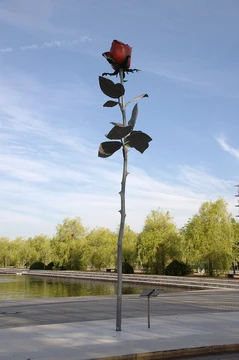
Takashi Murakami
Japanese artist who blurs boundaries between high art and commerce.

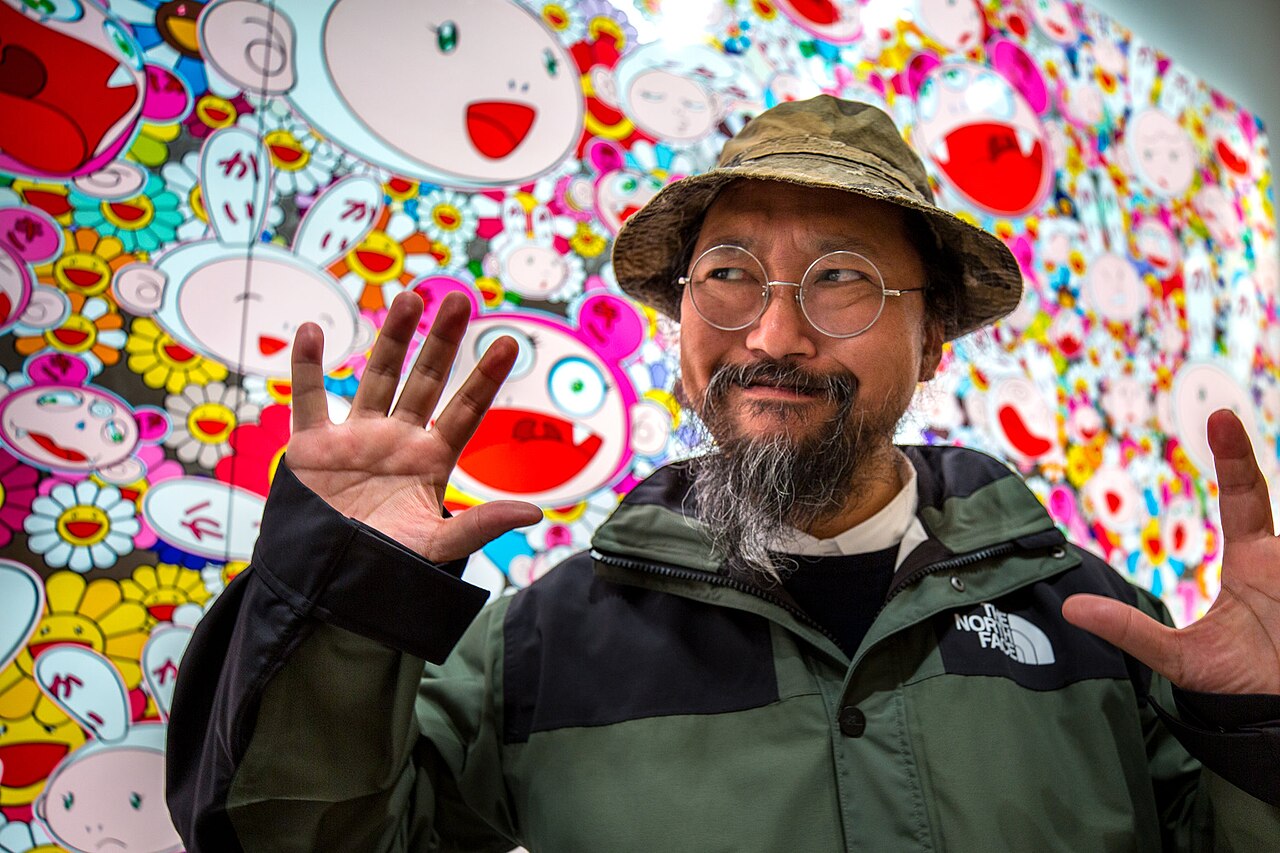
Beulagpinkeu · CC BY-SA 3.0
Takashi Murakami (born February 1, 1962) is a Japanese contemporary artist whose work spans fine arts such as painting and sculpture, as well as commercial media including fashion, merchandise, and animation. He is known for blurring the line between high and low arts, drawing from the aesthetic characteristics of the Japanese artistic tradition and the nature of postwar Japanese culture. He has designed covers for several hip hop albums, including Kanye West's *Graduation* (2007), Future's eponymous fifth studio album (2017), West and Kid Cudi's *Kids See Ghosts* (2018), and Juice Wrld's posthumous *The Party Never Ends* (2024). Murakami is the founder and President of the art trading company Kaikai Kiki Co., Ltd. and was the founder and organizer of the biannual art fair Geisai.
- born
- February 1, 1962
- field
- Contemporary art, commercial media
- nationality
- Japanese
- known_for
- Blurring high and low arts, Superflat theory, collaborations with Louis Vuitton
Verified Timeline
Lore & Background
Murakami was born and raised in Tokyo, Japan. From early on, he was a fan of anime and manga and hoped to work in the animation industry. He attended Tokyo University of the Arts to acquire the drafting skills necessary to become an animator, but eventually majored in Nihonga, the 'traditional' style of Japanese painting. He earned his master's degree in 1988 and a Ph.D. in Nihonga in 1993, but gradually became disillusioned with its insular, highly political world and started to explore more contemporary artistic styles. Much of his early work was done in the spirit of social criticism and satire, including performance art (*Osaka Mixer Project*, 1992), parodies (*Dobozite Dobozite Oshamanbe*, 1993), and conceptual works (*Randoseru Project*, 1991). He also began developing his own pop icon, 'Mr. DOB', which would later develop into a form of self-portraiture. Though he garnered attention, many of his early pieces were not initially well received in Japan. In 1994, Murakami received a fellowship from the Asian Cultural Council and participated in the PS1 International Studio Program in New York City for a year. During his stay, he was exposed to and highly inspired by Western contemporary artists such as Anselm Kiefer and especially the simulationism of artists such as Jeff Koons. He established a small studio, which, together with the Hiropon Factory in Japan, became the precursor to his company Kaikai Kiki. In 2000, Murakami published his 'Superflat' theory in the catalogue for a group exhibition of the same name that he curated for the Museum of Contemporary Art, Los Angeles. The theory posits that there is a legacy of flat, 2-dimensional imagery from Japanese art history in manga and anime, and serves as a commentary on postwar Japanese society in which differences in social class and popular taste have 'flattened,' producing a culture with little distinction between 'high' and 'low'.
Reader's Guide
Takashi Murakami's significance lies in his systematic dismantling of the boundary between high art and commercial culture, a project he has pursued through painting, sculpture, fashion collaborations, and album cover designs. His Superflat theory provided a conceptual framework that links traditional Japanese art to contemporary subcultures like anime and manga, while his practice of repackaging elements usually considered 'low' or subcultural and presenting them in the 'high-art' market—then further flattening the playing field by repackaging his 'high-art' works as merchandise such as plush toys and T-shirts—makes his approach concrete. His long-lasting collaboration with Louis Vuitton, beginning in 2002 at the invitation of designer Marc Jacobs, made him widely known for blurring the line between 'high art' and commercialism and elevated him to celebrity status in Japan. Murakami's work with hip hop artists—including cover art for Kanye West's *Graduation*, Future's eponymous album, *Kids See Ghosts*, and Juice Wrld's posthumous *The Party Never Ends*—extended his influence into popular music. He also directed an animated music video for West's song 'Good Morning' and later re-appropriated these projects by incorporating their imagery into his paintings and sculptures. Through his company Kaikai Kiki and the art fair Geisai, he has also managed several artists and curated exhibitions that introduce Japanese creative culture overseas. Asked about straddling the line between art and commercial products, Murakami responded: 'I don't think of it as straddling. I think of it as changing the line.'
Did You Know?
- Murakami earned a Ph.D. in Nihonga in 1993, but became disillusioned with its insular, highly political world.
- His sculpture *My Lonesome Cowboy* sold for $15,100,000 at Sotheby's New York in 2008, making it his most expensive piece to date.
- He founded the biannual art fair Geisai and is the President of the art trading company Kaikai Kiki Co., Ltd.
- Murakami designed the cover for Juice Wrld's posthumous album *The Party Never Ends* (2024).
- He directed an animated music video for Kanye West's song 'Good Morning' and later re-appropriated that imagery into his paintings and sculptures.
From Anime Dreams to Nihonga: Academic Roots and Early Satire
Born in Tokyo in 1962, Murakami grew up immersed in anime and manga, originally dreaming of a career in animation. He enrolled at Tokyo University of the Arts to build the drafting skills he believed an animator needed, but his path shifted toward Nihonga—the traditional Japanese painting discipline rooted in centuries-old conventions and techniques. He completed a master's degree in 1988 and a doctorate in 1993, yet the insular and heavily political atmosphere surrounding that field gradually lost its appeal. At the same time, he grew frustrated with what he saw as the broader Japanese contemporary art scene's heavy reliance on Western trends, believing it to be 'a deep appropriation of Western trends.' This double disillusionment fueled a body of early work steeped in social satire: the *Osaka Mixer Project* performance in 1992, the 1993 parody *Dobozite Dobozite Oshamanbe*, and the conceptual *Randoseru Project* of 1991. During this period he also introduced Mr. DOB, a recurring pop-icon figure that would evolve into a kind of self-portrait. Despite the attention these pieces drew, many were met with resistance in Japan.
Superflat: Theory, Curation, and Cultural Commentary
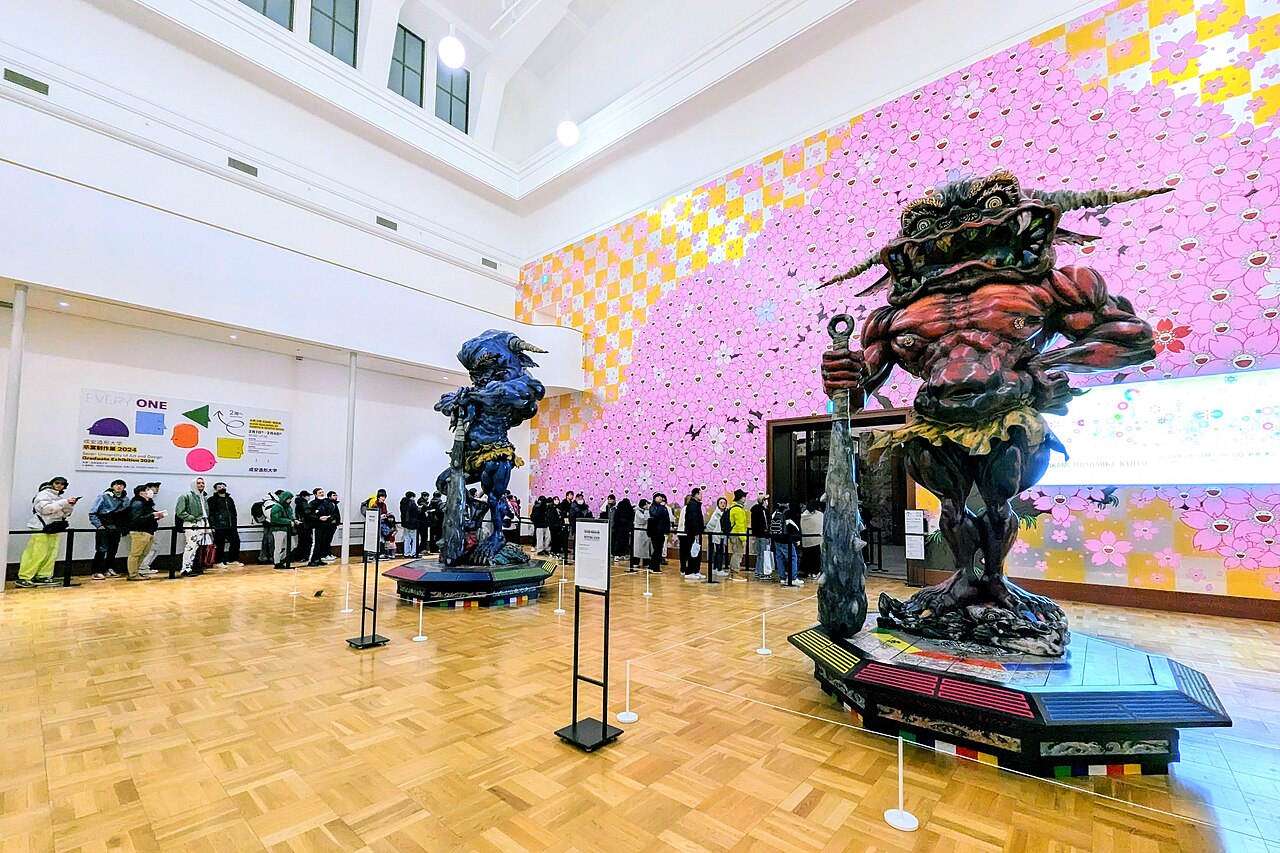
In 2000, Murakami formalized what would become his signature intellectual framework when he published the Superflat theory in the catalogue for a group show he curated at the Museum of Contemporary Art in Los Angeles. The core argument traces a lineage of flat, two-dimensional imagery running through Japanese art history and into manga and anime, distinguishing this visual language from Western traditions by its emphasis on surface and broad planes of color. But Superflat is also a cultural diagnosis: Murakami argued that postwar Japanese society had flattened the old hierarchies between social classes and between popular and elite taste, producing a culture where 'high' and 'low' barely register as different categories. He expanded the idea through major curatorial projects—*Coloriage* at the Fondation Cartier pour l'art contemporain in Paris in 2002 and *Little Boy: The Arts of Japan's Exploding Subculture* at the Japan Society in New York in 2005, which was named after Little Boy—both of which introduced lesser-known strands of Japanese creative culture to international audiences. His curatorial reach continued to grow, encompassing artists like Kazunori Hamana, Yuji Uedaa, and Otani Workshop at Blum & Poe in 2016 and the *Juxtapox x Superflat* show at the Vancouver Art Gallery the same year.
The Factory, Fashion, and the High-Low Collapse
By the mid-1990s, Murakami had outgrown the solo-artist model. In 1996 he launched the Hiropon Factory, his production workshop, designed to let him work at a larger scale and in a more diverse array of media. The structure deliberately echoed the atelier system which has long existed in Japanese painting, printmaking and sculpture and is common to anime and manga enterprises, such as Hayao Miyazaki's Studio Ghibli. In 2001, Hiropon Factory was incorporated as Kaikai Kiki Co., Ltd., through which Murakami went on to manage several artists and organize the biannual Geisai art fair. The factory's commercial ambitions found their most visible expression in 2002, when designer Marc Jacobs invited Murakami to collaborate with Louis Vuitton. His reimagining of the company's monogram on a series of handbags became a huge commercial success. Although he had earlier worked with fashion labels such as Issey Miyake Men by Naoki Takizawa, the Vuitton partnership cemented his reputation for blurring the line between 'high art' and commercialism and propelled him into celebrity status back home in Japan.
Pop-Culture Crossovers and Market Milestones
Murakami's willingness to cross into mainstream pop culture reached a new register in the music world. He designed the cover art for Kanye West's 2007 album *Graduation* and directed an animated music video for the track 'Good Morning.' He returned to West's orbit in 2018 with the cover for the collaboration album *Kids See Ghosts*, shared with Kid Cudi, and in 2017 he provided artwork for Future's eponymous fifth studio album. In 2024 his name appeared on the cover of Juice Wrld's posthumous release *The Party Never Ends*, underscoring how deeply his visual language had become embedded in hip-hop's visual vocabulary. Murakami later re-appropriated the *Graduation* and 'Good Morning' imagery, folding it back into his fine-art practice—a move consistent with his broader habit of cycling motifs between commercial and gallery contexts. His market presence matched his cultural reach: the sculpture *My Lonesome Cowboy*, a companion piece to his earlier *Hiropon* figure, fetched $15,100,000 at a 2008 Sotheby's auction in New York, making it his most expensive work to that point.
Gallery
Frequently Asked Questions
Who is Takashi Murakami?
Takashi Murakami is a Japanese contemporary artist born on February 1, 1962, who creates work across fine art, fashion, animation, and commercial design. He is widely recognized for deliberately erasing the wall between elite gallery culture and mass-market pop imagery.
What is Superflat and why did Murakami coin it?
Superflat is an artistic theory Murakami developed to describe how Japanese visual culture has long flattened depth and narrative into bold, two-dimensional surfaces. He uses the concept to frame his own paintings and sculptures as a bridge between traditional ukiyo-e aesthetics and the saturated look of modern anime and consumer branding.
Which major brand and music collaborations is Murakami known for?
He designed a celebrated collection of handbags and accessories for Louis Vuitton in the mid-2000s, bringing his signature smiling flower motif onto luxury fashion. He also partnered with Kanye West on the 'Don't Call Me MCA' album cover and related visual projects, extending his influence into hip-hop culture.
What media and art forms does Murakami work in?
His practice spans oil painting, large-scale sculpture, hand-drawn animation, and graphic design for merchandise. He also runs a studio model where trained assistants help execute his works, blending the solo-artist tradition with a production pipeline more typical of commercial studios.
Why do critics consider Murakami important in the history of contemporary art?
He challenged the long-standing hierarchy that placed fine art above popular and commercial culture, arguing that both deserve equal critical attention. By pulling anime-style imagery into major museum exhibitions and pushing gallery aesthetics onto consumer products, he reshaped how audiences and institutions define the boundaries of 'serious' art.
More in Modern & Contemporary Artists 25-29
Elsewhere in the Modern & Contemporary Artists universe
Spotted an error? Know more?
This is a living reference — every entry is fact-audited, and reader corrections feed straight into our audit queue. Suggest an edit · See this site's audit record